
The Informed Buyer’s Guide to Due Diligence
Know What You’re Taking On Before It Becomes Yours
A practical guide to what residential due diligence investigates, why some questions require specialized expertise, and what you may be agreeing to take responsibility for at closing.
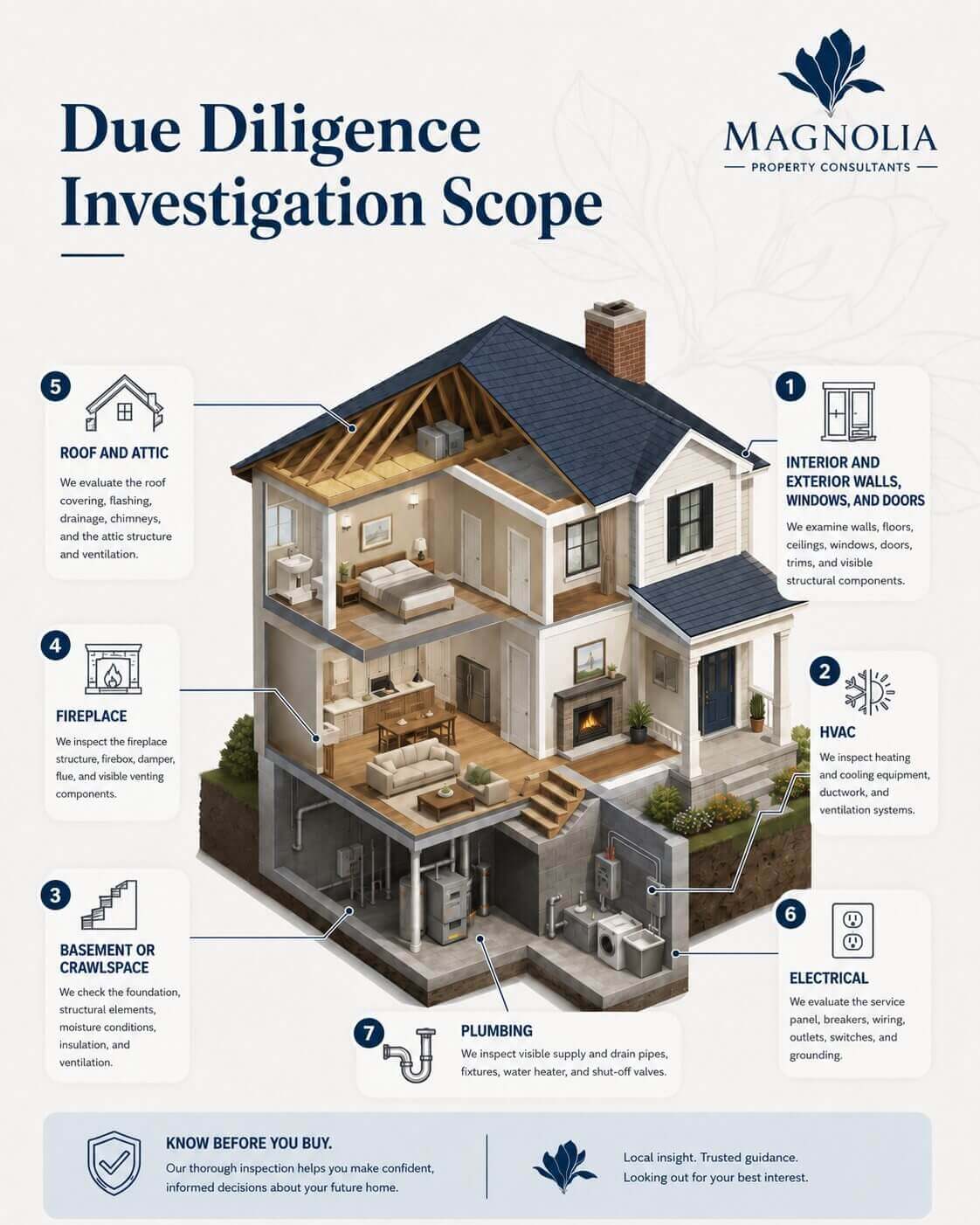
Free Download
Get the Informed Buyer’s Guide
Enter your email and we will send you the guide. No sales sequence — the guide, and a note if you would like to talk with a Client Care Advisor.
We use your email to send the guide. We do not sell or share it.
I
Know What You’re Taking On Before It Becomes Yours
Every home has conditions that deserve attention.
The purpose of Due Diligence is not to prove that a home is perfect. It is to understand the property well enough to make an informed decision about the responsibility you may be taking on.
Some conditions are ordinary parts of homeownership. Others may require specialized expertise, meaningful repairs, or significant financial commitment. And some simply cannot be understood by looking at the home.
The important question is:
What would you want to understand before the responsibility becomes yours?
Magnolia approaches that question through residential Due Diligence.
A Magnolia Consultant investigates the home as a whole, using hands-on construction experience, building-science reasoning, infrared scanning, moisture measurements, and other diagnostic tools to understand conditions in context.
When the home or a particular concern calls for greater professional depth, additional specialists can investigate within their own disciplines.
The goal is not simply to find more things wrong with the home.
It is to help you understand what deserves attention, what remains uncertain, and what you may be agreeing to take responsibility for at closing.
II
Why One Professional Perspective Is Not Always Enough
A home is not one system.
It is a structure, roof, drainage system, electrical system, heating and cooling system, plumbing system, sewer system, and building envelope. Depending on the property, it may also include fireplaces, pools, generators, environmental conditions, and other specialized components.
Your Magnolia Consultant investigates the home as a whole and connects the evidence into a broader understanding of the property.
But some questions require specialized equipment or deeper trade expertise.
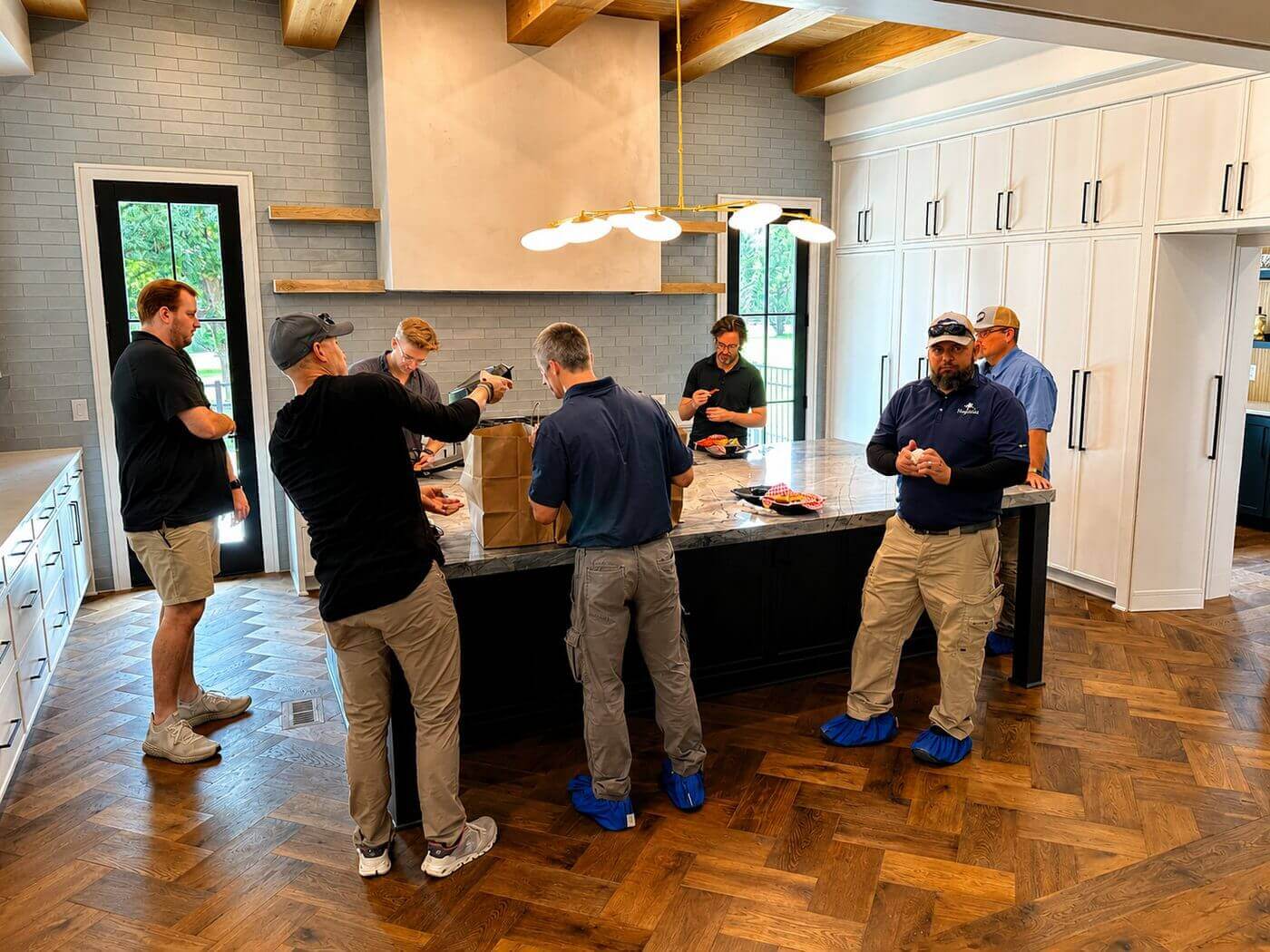

The right professionals are assembled before Due Diligence begins.
III
What Could You Be Taking Responsibility For?
At closing, the home becomes yours.
So do its systems, repair needs, maintenance responsibilities, and unresolved conditions.
The examples below are not predictions that a particular home has these problems. They illustrate why certain questions may be worth answering while you still have the opportunity to investigate them.
Specialist / Service
Scope of Investigation
Responsibility Assumed by Buyer at Closing
Worst Credible Consequence
Termite / WDO Professional
Focused evaluation of accessible areas for termites and other wood-destroying organisms, visible damage indicators, treatment evidence, possible entry pathways, and conditions conducive to activity.
Undetected activity, treatment needs, and repair of affected wood or structural components become the owner’s responsibility.
Termites cause more than $5 billion in U.S. property damage each year, and that damage is typically not covered by homeowners insurance. A buyer could inherit both an infestation and the repair responsibility without understanding either before closing.
Radon Monitoring
Continuous monitoring measures the concentration of radon inside the home—something that cannot be determined by sight or smell.
If elevated radon is present, mitigation and management of the condition become the owner’s responsibility.
EPA estimates radon causes approximately 21,000 lung-cancer deaths in the United States each year. The only way to know the radon level in a particular home is to test it.
Structural Contractor
Focused evaluation of foundation, framing, settlement, cracking, movement, drainage, water intrusion, previous repairs, and other visible structural concerns, with repair scope and pricing where applicable.
Stabilization, foundation repair, drainage correction, or other structural work not defined before closing becomes the buyer’s responsibility.
Foundation repairs average roughly $2,225–$8,135, while settling repairs can reach $25,000 and underpinning projects can reach $30,000. A visible crack can represent a very different responsibility once its cause and repair are understood.
Licensed HVAC Contractor
Deeper diagnostic evaluation of heating and cooling equipment, including operation, equipment condition, refrigerant pressures, electrical measurements, motors, capacitors, installation concerns, maintenance needs, and repair or replacement issues.
Repair or replacement of deficient heating and cooling equipment becomes the owner’s responsibility.
An HVAC system can operate during an evaluation and still be approaching a significant repair or replacement. Current national estimates place HVAC replacement at roughly $5,000–$22,000, depending on the equipment and work required.
Sewer Scope
A camera travels through the accessible main sewer line to identify roots, blockages, separated joints, deterioration, damaged pipe sections, and other visible concerns.
Excavation, repair, replacement, and restoration associated with an underground sewer defect become the owner’s responsibility.
Magnolia’s experience places a minimum sewer repair above $3,000. Replacement will often exceed $10,000 and can exceed $15,000 when the line is beneath a driveway, garage, or other concrete.
Chimney Contractor
Focused evaluation of accessible masonry, flues, liners, flashing, venting, moisture conditions, deterioration, and repair or replacement needs.
Chimney repair or replacement required after closing becomes the owner’s responsibility.
The difference between a manageable chimney concern and a replacement can be substantial. Current cost data places full chimney replacement at roughly $10,000 for many projects, with some reaching $15,000–$20,000 or more depending on height, material, and extent of damage.
Pool Professional
Focused evaluation of pool structure and operating equipment, including pumps, filtration, heaters, circulation, visible plumbing, controls, automation, and leak conditions where applicable.
Leaks, failed equipment, deteriorated surfaces, liner replacement, and other pool repairs become part of the buyer’s ownership responsibility.
A pool can appear functional while concealing expensive repair needs. Individual repairs can run into the thousands of dollars; liner replacement averages about $2,588, fiberglass materials can reach $8,000, and major concrete resurfacing can reach $10,000–$20,000.
Roofing Contractor
Trade-specific evaluation of visible roofing materials, deterioration, damaged areas, installation concerns, previous repairs, leakage concerns, and repair or replacement needs, including scope and pricing where applicable.
Repairing or replacing a deteriorated roofing system becomes the owner’s responsibility.
A concern believed to require a localized repair may ultimately require replacement. Current national data puts professional roof replacement at about $9,605 on average, with costs varying widely based on roof size, material, pitch, and complexity.
Generator Test & Panel Audit
A controlled power-loss test observes whether the standby generator starts, whether the transfer system responds, and whether intended circuits receive backup power, along with a focused electrical-panel review.
Correcting generator, transfer-system, panel, or circuit deficiencies becomes the owner’s responsibility.
A generator can start and still fail to power the circuits the homeowner expects. The buyer may not discover an incorrectly configured transfer or emergency-load panel until an actual outage—when essential loads such as refrigeration, selected outlets, or heating-related equipment fail to receive backup power. Manufacturer guidance confirms that only specifically selected branch circuits are protected in these systems.
Air Quality / Mold Analysis
Air samples are collected and sent to an independent laboratory for mold analysis, adding environmental data to the investigation of moisture and building conditions.
Further investigation, moisture correction, removal of affected materials, and remediation become the owner’s responsibility if a condition is discovered after closing.
Professional mold remediation averages about $2,368, with most projects falling between approximately $1,223 and $3,756. More extensive conditions involving walls or HVAC systems can reach $10,000–$20,000 or more, before repairs to the underlying moisture source or damaged materials are considered.
Radon figures: U.S. Environmental Protection Agency. Sewer figures reflect Magnolia’s engagement experience in Middle Tennessee. Remaining cost ranges reflect current published national repair-cost data and vary by market, scope, and property.
The point is not that every home has one of these problems.
It is that the meaning of an unanswered question changes after closing.
Before closing, it is information that can help you decide.
After closing, it may become your repair, your expense, your maintenance responsibility, or your health and safety concern.
IV
From Finding to Financial Responsibility
Finding a condition is only the beginning.
Imagine being told:
“There appears to be a structural concern.”
That matters.
But if you are deciding whether to take responsibility for the home, you probably have more questions:
- What is actually happening?
- How significant is it?
- What will correcting it involve?
- What might it cost?
Knowing what a repair may involve changes the conversation.
V
The Informed Buyer
An informed buyer does not need a perfect home.
And Due Diligence cannot remove every uncertainty that comes with owning one.
What it can do is help you answer the questions that matter before you make a meaningful commitment.
- Was the home investigated at the appropriate depth?
- Were the important questions evaluated by the right professionals?
- Do I understand what deserves my attention?
- Do I understand what significant repairs may involve—and what they may cost where that information is available?
Am I comfortable taking responsibility for this home knowing what I know now?
That is the purpose of Magnolia Due Diligence.
Not to make the decision for you.
Not to tell you whether to buy the home.
But to help you understand the property, the meaningful conditions within it, and the responsibilities you may be agreeing to make your own.
Considering a Home?
You do not have to determine every investigation or professional you may need on your own.
A Magnolia Client Care Advisor begins by understanding your concerns, the home you are considering, and the transaction in front of you.
From there, Magnolia helps determine the appropriate level of Due Diligence and professional involvement.
You bring us the home. We help determine what it needs.
×
Client Care
Please Have a Client Advisor Call Me
Share your contact details and a Magnolia Client Advisor will call you.